 Teltonika ATRM50 Rugged 5G router built for transportation, 4x M12 Gigabit Ethernet ports, M12 power input
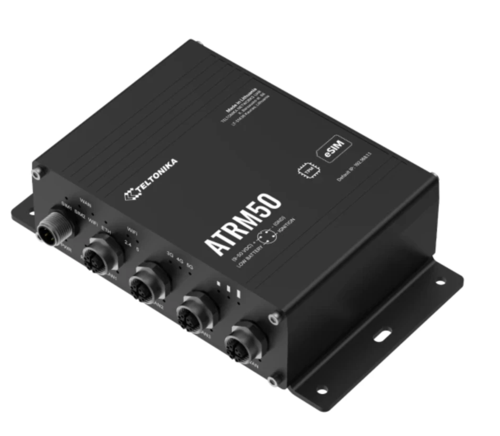
Rugged 5G transportation router with M12 Gigabit Ethernet, dual SIM, eSIM, Wi-Fi and GNSS for connected vehicles and railway networks.
TELTONIKA ATRM50 5G TRANSPORTATION ROUTER
The Teltonika ATRM50 is a rugged 5G router designed for connected vehicles, public transport and railway applications. Combining four M12 Gigabit Ethernet ports, dual SIM with eSIM support, dual-band Wi-Fi and GNSS positioning, it provides a central communications platform for onboard equipment, fleet connectivity and remote management.
Secure M12 Connections for Vehicle Networks
Four M12 X-coded Gigabit Ethernet ports provide mechanically secure connections for installations exposed to vibration. The M12 power input and integrated mounting bracket further support permanent installation in vehicles and transport equipment.
Connect onboard cameras, ticketing systems, passenger information displays and other Ethernet devices through one WAN and three LAN ports. Each port supports speeds of up to 1 Gbps.
5G Connectivity with Automatic SIM Switching
The ATRM50 supports 5G standalone and non-standalone networks, with 4G LTE fallback. Its cellular modem supports theoretical download speeds of up to 3.4 Gbps, providing capacity for applications such as remote diagnostics, surveillance uploads and onboard internet access.
Dual physical SIM slots and eSIM support allow automatic switching when configured conditions occur, including weak signal, network failure, roaming or data limits. This provides an alternative carrier connection as vehicles travel between coverage areas. SIM switching uses the cellular connection sequentially; it does not provide two simultaneous independent cellular links.
Actual throughput depends on coverage, operator services, antenna installation and network conditions. Individual Ethernet connections are limited to 1 Gbps.
Dual-Band Wi-Fi for Onboard Devices
Integrated Wi-Fi 5 provides 2.4 GHz and 5 GHz wireless connectivity for staff devices, onboard equipment and passenger access. Multiple wireless networks and client separation help installers organise access around different users and services.
The router also supports Wi-Fi WAN, allowing a suitable external wireless network to serve as an internet connection where available.
GNSS Positioning and Vehicle Status Monitoring
Built-in GNSS supports location tracking, with GPS, GLONASS, BeiDou, Galileo and QZSS compatibility. Position information can be integrated into fleet monitoring workflows, while configurable geofencing supports location-based applications.
Dedicated inputs for ignition detection and low-battery monitoring provide additional vehicle status information, helping operators monitor conditions alongside network connectivity.
RutOS Networking and Remote Fleet Management
Teltonika’s RutOS operating system provides firewall controls, VLANs, routing, connection monitoring and VPN functionality. These tools help separate onboard services and establish secure connections between vehicles and central systems.
Compatibility with Teltonika Remote Management System (RMS) allows central monitoring, configuration and firmware updates across deployed routers. This is particularly useful for fleets where accessing each vehicle individually would increase support time. RMS services and cellular data plans should be provisioned separately to suit the deployment.
Designed for Demanding Transport Installations
The ATRM50 carries EN 50155 and EN 45545-2 railway certifications, alongside ITxPT certification. Its aluminium enclosure and −40°C to +75°C operating range suit demanding onboard environments.
The enclosure is rated IP30, so the router should be installed in a protected location. Plan suitable M12 cabling, power connections and external antennas before installation; supplied accessories vary by ordering code. For applications exposed to significant vibration, Teltonika recommends using eSIM or an appropriate industrial-grade physical SIM.
Teltonika ATRM50 Technical Specifications
|
Specification |
Details |
|---|---|
|
Product type |
Rugged 5G transportation router |
|
Cellular connectivity |
5G Sub-6 GHz SA/NSA; 4G LTE and 3G fallback |
|
Maximum cellular download rate |
Up to 3.4 Gbps theoretical |
|
LTE capability |
Cat 19 download; Cat 18 upload |
|
SIM interfaces |
2 × Mini SIM (2FF), plus eSIM support |
|
eSIM profiles |
Up to 7 stored profiles; data plans excluded |
|
Ethernet |
4 × M12 X-coded, 8-pin female, 10/100/1000 Mbps |
|
Default Ethernet roles |
1 × WAN, 3 × LAN |
|
Wi-Fi |
Dual-band Wi-Fi 5, 802.11b/g/n/ac Wave 2, MU-MIMO; up to 867 Mbps PHY rate |
|
GNSS |
GPS, GLONASS, BeiDou, Galileo, QZSS |
|
Antenna connections |
4 × SMA cellular; 2 × RP-SMA Wi-Fi; 1 × SMA GNSS |
|
Vehicle inputs |
Ignition detection and low-battery monitoring |
|
USB |
1 × USB-A, USB 2.0 |
|
Operating system |
RutOS |
|
Management |
Web interface, SSH, SNMP, RMS |
|
Power connection |
M12 A-coded, 4-pin male |
|
Input voltage |
9–50 V DC |
|
Power consumption |
Idle: less than 5.5 W; maximum: less than 16 W |
|
Housing |
Anodised aluminium |
|
Dimensions |
167 × 46.2 × 112.4 mm (W × H × D) |
|
Weight |
550 g |
|
Mounting |
Flat surface; integrated mounting bracket |
|
Operating temperature |
−40°C to +75°C |
|
Operating humidity |
10–90%, non-condensing |
|
Ingress protection |
IP30 |
|
Transport certifications |
EN 50155, EN 45545-2, ITxPT |
|
Standard package |
Router, quick start guide and hex key; contents vary by ordering code |