 Ericsson Enterprise Wireless TBD3-0400-C6-EA-M S400 router with WiFi and 3 Year NetCloud IoT Foundation Plan
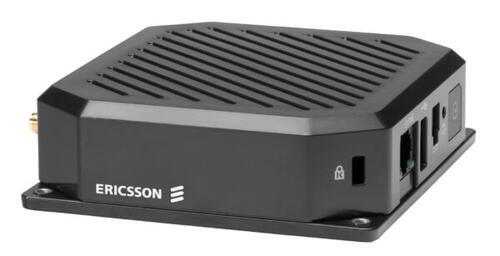
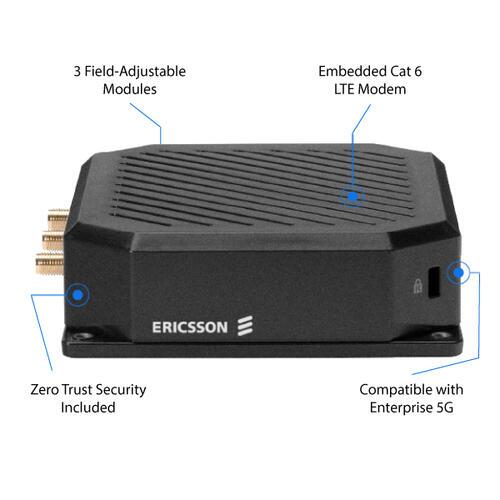
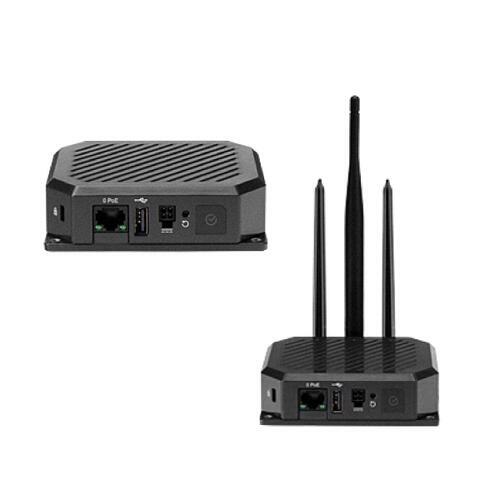
5-yr NetCloud IoT Foundation Plan, Secure Connect SASE and S400 router with WiFi (300 Mbps modem), with AC power supply and antennas, EMEA/APAC
The Ericsson Enterprise Wireless Solutions S400 is a compact, semi-ruggedised 4G LTE router designed to provide secure and reliable connectivity for IoT devices, digital signage, kiosks, building-management systems, surveillance equipment and light industrial applications. Formerly known as Cradlepoint, Ericsson Enterprise Wireless Solutions combines the Wi-Fi-enabled S400 router with a three-year NetCloud IoT Foundation Plan under order SKU TBD3-0400-C6-EA-M, delivering essential cloud management and dependable cellular connectivity in a cost-effective IoT solution.
Antenna Connectors:
- Cellular/LTE: 2 × female SMA connectors, supporting 2×2 MIMO. An external antenna requires 2 × SMA male plugs.
- Wi-Fi: 1 × female RP-SMA connector, supporting 1×1 SISO Wi-Fi. An external antenna requires 1 × RP-SMA male plug.
- GNSS/GPS: No separate connector. Passive GNSS is multiplexed through the cellular antenna system.
Reliable 4G LTE connectivity for IoT applications
The Ericsson S400 features an embedded LTE Category 6 modem with 2×2 MIMO, carrier aggregation and peak cellular speeds of up to 300 Mbps download and 50 Mbps upload. Actual performance depends on the mobile network, signal conditions and selected data plan.
Two nano-SIM slots provide flexibility when selecting mobile network services. SIM-based automatic carrier selection and configurable WAN failover help maintain connectivity across distributed IoT installations.
The EA regional modem supports a broad selection of LTE bands used throughout Europe, Australia and New Zealand, making the S400 suitable for local IoT, telemetry and remote connectivity deployments.
Integrated Wi-Fi 5 and Gigabit Ethernet
The Wi-Fi-enabled S400 provides single-radio, dual-band 802.11ac Wi-Fi 5, operating on either the 2.4 GHz or 5 GHz band. It can provide local wireless access for IoT devices, service equipment and authorised users where a physical connection is not practical.
A Gigabit Ethernet RJ45 port can be configured as either LAN or WAN. This allows the S400 to connect a wired IoT device, use an external wired internet service, or operate as a cellular gateway for a small local network.
Three-year NetCloud IoT Foundation Plan
The included three-year NetCloud IoT Foundation Plan is Ericsson’s entry-level cloud-management package for the S400 and S450 router families. It is intended for organisations that need straightforward, reliable cellular connectivity and essential remote device management without the advanced analytics and assisted-support services included with higher-tier NetCloud plans.
For the three-year subscription term, administrators can use NetCloud Manager to centrally deploy, configure, monitor and troubleshoot the S400. This is particularly useful when managing routers installed at remote, unmanned or geographically dispersed IoT locations.
NetCloud IoT Foundation capabilities for the S400 include:
- Centralised device and group configuration
- Basic dashboards and device-status information
- Remote monitoring and troubleshooting
- Carrier-selection intelligence and failover
- Cellular, Ethernet and other WAN configuration
- Static and policy-based routing
- IPv4 and IPv6 networking
- DHCP and VLAN configuration
- Multiple Wi-Fi SSIDs
- Basic Wi-Fi security
- Zone-based firewall configuration
- Standard VPN protocols, including IPsec, GRE and OpenVPN
- Access to NetCloud Manager help and self-service technical resources
The Foundation Plan is well suited to “set and forget” IoT installations where the primary requirements are dependable cellular access, consistent configuration and the ability to remotely check or adjust the router. Support for Foundation deployments is self-service through Ericsson technical documentation, NetCloud Manager help resources and Enterprise Wireless University.
Compact, semi-ruggedised IoT router
Measuring only 100 × 105 × 31 mm, the Ericsson S400 can be installed in kiosks, roadside cabinets, digital signs, equipment enclosures and other space-constrained environments.
Its IP30-rated enclosure supports operating temperatures from -20°C to 60°C. The router has also been tested against selected MIL-STD-810H shock and vibration methods, making it suitable for light industrial and field-deployed applications.
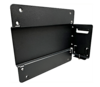
Optional DIN rail and ceiling mounting brackets provide additional installation flexibility.
Flexible power options
The S400 can be powered through a 9–33 VDC input or by 802.3af Power over Ethernet. Its low power consumption makes it suitable for remote IoT installations and equipment cabinets where available power may be limited.
Reverse-polarity and transient-voltage protection help protect the router when used with compatible DC power systems.
Expandable interfaces for specialised IoT equipment
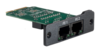
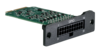
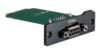
An integrated expansion slot allows the S400 to be adapted for different IoT environments. Optional expansion modules include:
- Two additional Fast Ethernet LAN/WAN ports
- An RS-232 DB9 serial interface
- A configurable 20-pin GPIO interface
These options allow the S400 to connect with industrial controllers, legacy serial equipment, sensors and specialised monitoring systems. A USB 2.0 Type-A port provides further interface flexibility.
Integrated GNSS positioning
Integrated GNSS functionality supports GPS, Galileo, GLONASS and BeiDou satellite constellations. Positioning data can be used for asset tracking, portable installations and other location-aware IoT applications.
Secure routing and network segmentation
The S400 provides a zone-based firewall, VPN connectivity, policy-based routing and support for up to 64 Layer 2 and Layer 3 VLANs. These capabilities help organisations separate connected IoT equipment from other network resources and securely transport data between remote installations and central systems.
The router supports up to five concurrent VPN tunnels, up to 32,000 concurrent TCP sessions and a typical deployment size of approximately 25 IoT clients.
Ericsson S400 TBD3-0400-C6-EA-M technical specifications
|
Specification |
Details |
|---|---|
|
Manufacturer |
Ericsson Enterprise Wireless Solutions, formerly known as Cradlepoint |
|
Order SKU |
TBD3-0400-C6-EA-M |
|
Router model |
S400-C6-EA |
|
Product type |
Cloud-managed, semi-ruggedised 4G LTE IoT router |
|
Included subscription |
Three-year NetCloud IoT Foundation Plan |
|
Cellular technology |
LTE Category 6, 3GPP Release 11; DC-HSPA+ |
|
Maximum LTE download |
Up to 300 Mbps |
|
Maximum LTE upload |
Up to 50 Mbps |
|
Carrier aggregation |
Up to 2CA downlink and 1CA uplink |
|
Cellular MIMO |
2×2 MIMO |
|
SIM slots |
2 × 4FF nano-SIM |
|
Carrier selection |
SIM-based automatic carrier selection |
|
LTE FDD bands |
B1, B3, B5, B7, B8, B20, B28 and B32 |
|
LTE TDD bands |
B38, B40, B41, B42 and B43 |
|
3G technologies |
UMTS, WCDMA, HSPA, HSPA+ and DC-HSPA |
|
3G bands |
B1, B3, B5 and B8 |
|
Cellular antenna connections |
2 × SMA |
|
Ethernet |
1 × Gigabit Ethernet RJ45, LAN/WAN selectable |
|
Wi-Fi |
Single-radio, dual-band 802.11ac Wi-Fi 5 |
|
Wi-Fi operation |
2.4 GHz or 5 GHz, non-concurrent |
|
Wi-Fi MIMO |
1×1 |
|
Maximum Wi-Fi rate |
150 Mbps at 2.4 GHz; 433 Mbps at 5 GHz |
|
Wi-Fi antenna connection |
1 × RP-SMA |
|
Wi-Fi standards |
802.11ac, 802.11k and 802.11v |
|
Hardware Wi-Fi security capability |
WPA/WPA2/WPA3 Personal, WPA2/WPA3 Enterprise and Open |
|
USB |
1 × USB 2.0 Type-A |
|
Expansion |
1 × expansion-module slot |
|
Optional expansion modules |
Dual Fast Ethernet, RS-232 DB9 or 20-pin GPIO |
|
GNSS |
GPS, Galileo, GLONASS and BeiDou |
|
Stateful firewall throughput |
Up to 95 Mbps |
|
Point-to-point IPsec throughput |
Up to 20 Mbps |
|
Concurrent VPN tunnels |
Up to 5 |
|
Concurrent TCP sessions |
Up to 32,000 |
|
Typical IoT client count |
Approximately 25 |
|
VLAN support |
Up to 64 Layer 2 or Layer 3 VLANs |
|
Routing and VPN protocols |
Static and policy routes; IPsec, GRE and OpenVPN |
|
Power input |
9–33 VDC or 802.3af PoE |
|
Typical power consumption |
4.1 W |
|
Heavy-load power consumption |
5.8 W |
|
Operating temperature |
-20°C to 60°C |
|
Storage temperature |
-20°C to 70°C |
|
Operating humidity |
5% to 95%, non-condensing |
|
Ingress protection |
IP30 |
|
Dimensions |
100 × 105 × 31 mm |
|
Weight |
221 g |
|
Housing |
Plastic, semi-ruggedised enclosure |
|
Regional compliance |
RCM for Australia and New Zealand; CE; UKCA; GCF |
|
Recommended applications |
IoT connectivity, digital signage, kiosks, surveillance, building controls, SCADA, sensors and remote monitoring |