 Teltonika RUTM54 Industrial Cellular 5G Wi-Fi Gigabit Router with Dual SIM, Dual Radio plus eSIM
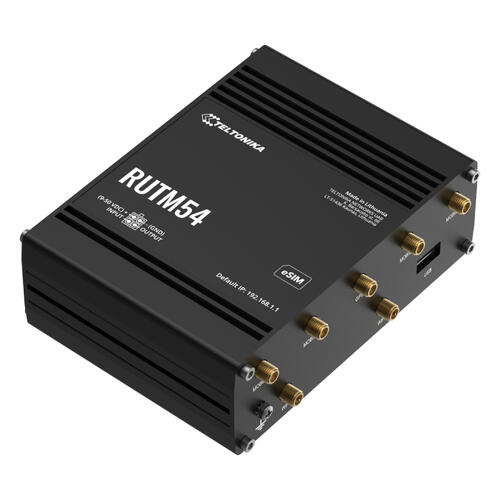
Teltonika RUTM54 industrial 5G router with global Telit modem, dual SIM, eSIM, five Gigabit ports, Wi-Fi 5, automatic failover and RMS.
Teltonika RUTM54 5G industrial router with dual SIM and eSIM
The Teltonika RUTM54 is a high-performance industrial 5G router combining a global Telit cellular modem, dual SIM, eSIM, five Gigabit Ethernet ports and dual-band Wi-Fi 5. Designed for demanding business, IoT and remote-site deployments, it provides fast primary connectivity with multiple automatic failover options and centralised management through Teltonika RMS.
Global 5G connectivity with 4G fallback
The RUTM54 supports both Standalone and Non-Standalone 5G architectures, delivering theoretical mobile download speeds of up to 3.4 Gbps. Its globally focused Telit modem makes it suitable for organisations deploying a consistent router platform across multiple countries or cellular networks.
Where 5G service is unavailable, the router can fall back to LTE Cat 19 connectivity. Actual speeds will depend on the mobile operator, available spectrum, network congestion, signal conditions and antenna installation.
Four external cellular antenna connections support 4×4 MIMO, helping the router make effective use of modern 5G and LTE networks.
Dual SIM and eSIM for connection continuity
Two physical SIM slots and an integrated consumer eSIM give network designers several ways to build cellular redundancy into a deployment. The eSIM can store up to seven profiles, enabling supported carrier profiles to be downloaded, selected and removed without physically changing a SIM card.
RutOS can switch between mobile connections according to defined conditions, including weak signal, data limits, roaming status, network availability or connection failure. This makes the RUTM54 well suited to unattended sites where maintaining connectivity is more important than remaining with a single carrier.
A compatible eSIM service and mobile data plan are required separately.
Five Gigabit Ethernet ports for local devices and WAN failover
The RUTM54 provides five 10/100/1000 Mbps Ethernet ports, comprising one WAN port and four LAN ports by default. The WAN interface can be used for a fixed-line Internet service, allowing 5G to operate as the primary connection or as an automatic cellular backup.
The four Gigabit LAN interfaces can directly connect equipment such as switches, cameras, computers, digital displays, controllers and other IP devices. This makes the router practical for branches, temporary sites and distributed installations without necessarily requiring a separate Ethernet switch.
Dual-band Wi-Fi 5 for local access
Integrated dual-band Wi-Fi 5 provides wireless connectivity on both the 2.4 GHz and 5 GHz bands, with a combined maximum wireless rate of up to AC867. MU-MIMO support helps the router serve multiple connected clients more efficiently.
The wireless interface can operate as an access point or client, allowing the RUTM54 to provide local Wi-Fi or use an existing wireless network as another WAN source. Guest networks, wireless security settings and client access controls can be administered through RutOS.
Automatic failover across cellular, Ethernet and Wi-Fi
The RUTM54 can monitor its available Internet connections and automatically move traffic to a working alternative when the preferred connection fails. Supported sources include its physical WAN port, cellular services and Wi-Fi WAN.
Load balancing and policy-based routing provide further control over how available connections are used. These capabilities are valuable for retail, industrial, surveillance and remote-site applications where an Internet outage could interrupt monitoring, payments, communications or access to cloud services.
RutOS networking, VPN and security controls
Teltonika’s RutOS operating system provides advanced networking functions through a browser-based management interface. It supports VLANs, multiple DHCP modes, static and dynamic routing, firewall rules, traffic management and network address translation.
A broad selection of VPN technologies allows the RUTM54 to create secure connections between remote sites, cloud environments and central networks. Supported services include:
- OpenVPN
- IPsec
- WireGuard
- ZeroTier
- Tinc
- PPTP and L2TP
- GRE and DMVPN
- SSTP
- Stunnel
Additional protections include attack prevention, access control, web filtering, certificate management and configurable firewall policies.
Teltonika RMS remote router management
The RUTM54 is compatible with the Teltonika Remote Management System. RMS allows administrators and managed service providers to monitor connectivity, review router status, adjust configurations, install firmware and troubleshoot distributed devices through a central cloud platform.
RMS Connect and RMS VPN can also provide controlled remote access to equipment located behind the router, including devices that do not natively support cloud management. This can reduce site visits for maintenance and fault diagnosis.
RMS usage and services are licensed separately beyond any promotional allocation supplied with the device.
GNSS location services and industrial monitoring
Integrated GNSS supports GPS, GLONASS, BeiDou, Galileo and QZSS positioning systems. Location data can be used for mobile deployments, fleet-related applications or monitoring the position of portable infrastructure.
A digital input and open-collector digital output are provided through the four-pin power connector. These can support basic equipment monitoring, alarm input and remote control applications when configured through RutOS.
The router also supports commonly used monitoring and IoT services, including MQTT, Modbus TCP, SNMP, data-to-server functions and event notifications.
Built for industrial and remote-site deployments
An anodised aluminium enclosure, wide −40°C to +75°C operating temperature and 9–50V DC input make the RUTM54 suitable for cabinets, vehicles, machinery rooms and other demanding environments.
DIN-rail and surface-mounting options allow the router to be incorporated into control cabinets and communications enclosures. Appropriate mounting accessories, power equipment and external antennas should be selected according to the installation.
Typical applications include:
- Primary or backup Internet for branch and retail locations
- Remote monitoring and industrial IoT
- CCTV and mobile surveillance systems
- Smart infrastructure and utility installations
- Construction and temporary worksites
- Connected machinery and automation
- Digital signage and kiosks
- Multi-country cellular deployments
- Mobile and transport connectivity
RUTM54 or RUTC54
The RUTM54 is the appropriate choice when the main requirement is dependable global 5G routing, dual SIM and eSIM resilience, Gigabit Ethernet, Wi-Fi and RMS management.
The newer RUTC54 adds Wi-Fi 6 and considerably more computing resources, including 1 GB of DDR4 memory, 8 GB of eMMC storage and Docker container support. It is better suited to deployments that need applications or data processing to run directly on the router. For conventional 5G routing and failover, the RUTM54 provides the core connectivity capabilities without paying for an edge-computing platform that may not be required.
|
Specification |
Details |
|---|---|
|
Product type |
Industrial 5G cellular router |
|
Mobile modem |
Global Telit 5G modem |
|
5G support |
Sub-6 GHz, Standalone and Non-Standalone |
|
Maximum theoretical 5G download |
Up to 3.4 Gbps |
|
4G fallback |
LTE Cat 19 download; LTE Cat 18 upload |
|
3G fallback |
Supported where available |
|
Cellular MIMO |
4×4 MIMO |
|
Physical SIMs |
2 × SIM slots |
|
eSIM |
Consumer eSIM supporting up to seven stored profiles |
|
SIM functions |
Automatic switching, failover, roaming and data-limit rules |
|
Ethernet interfaces |
5 × 10/100/1000 Mbps RJ45 |
|
Default Ethernet configuration |
1 × WAN and 4 × LAN |
|
Wi-Fi standard |
Dual-band IEEE 802.11ac Wave 2 Wi-Fi 5 |
|
Wi-Fi bands |
2.4 GHz and 5 GHz |
|
Maximum Wi-Fi rate |
Up to AC867 |
|
Wi-Fi capabilities |
Access point, client mode and MU-MIMO |
|
GNSS |
GPS, GLONASS, Galileo, BeiDou and QZSS |
|
Cellular antenna connections |
4 × SMA female |
|
Wi-Fi antenna connections |
2 × RP-SMA female |
|
GNSS antenna connection |
1 × SMA female |
|
USB |
1 × USB 2.0 Type-A host port |
|
Digital input |
1 × digital input |
|
Digital output |
1 × open-collector output |
|
Processor |
MediaTek dual-core 880 MHz MIPS1004Kc |
|
Memory |
256 MB DDR3 |
|
Storage |
16 MB serial NOR flash and 256 MB serial NAND flash |
|
Operating system |
Teltonika RutOS |
|
Network functions |
VLAN, firewall, NAT, DHCP, QoS, load balancing, failover and routing controls |
|
VPN support |
OpenVPN, IPsec, WireGuard, ZeroTier, Tinc, DMVPN, GRE, SSTP, L2TP, PPTP and Stunnel |
|
Industrial and monitoring protocols |
MQTT, Modbus TCP, SNMP and data-to-server |
|
Remote management |
WebUI, CLI, SSH, SMS, Teltonika RMS and supported APIs |
|
Power input |
9–50V DC through four-pin industrial connector |
|
Enclosure |
Anodised aluminium |
|
Ingress protection |
IP30 |
|
Operating temperature |
−40°C to +75°C |
|
Dimensions |
132 × 44.2 × 95 mm |
|
Weight |
Approximately 530 g |
|
Mounting options |
DIN rail, wall or flat-surface mounting using appropriate accessories |